Another 5 star review!

The Lucid Spider

Charles R. Hinckley
Independently Published (2025)
ISBN: 979-8278924999
Reviewed by Demetria Head for Reader Views (02/2026)

The Lucid Spider by Charles R. Hinckley is a sci-fi crime thriller and book three in August Chase, the Psychic Detective Series. As the story opens, readers follow August “Gus” Chase, whose world is anything but normal. He confesses to his friend Mill that he’s had another dream about murder. Then he sees a vision of a red-haired woman on a subway platform who is clearly in danger. When he runs to the station, he sees the scene unfold exactly the same as his vision. By now, readers know that he’s a private investigator and a psychic. The drama that opens the story sets the tone for the unpredictable nature of the gift that Gus possesses.

I like how subtly the character development was done. Hinckley did a great job in creating August’s character with steady composure. He also has moral discipline. His development is also affected by the weight of his psychic abilities. Then there’s Jenny Lynch, who’s with law enforcement. She develops over time through gradual trust and acceptance of August’s unconventional gift. This also makes their partnership convincing. August’s friend, Mill, is the opposite and serves as the stable, conventional one. Their contrast is obvious, with Mill representing normalcy and August representing a divergence from it.

Hinckley’s style of writing reminds me of that classic detective noir with the paranormal suspense element. The pacing is brisk where there’s action, and it slows down when readers are taken inside Gus’s visions and inner conflicts. I loved the investigative scenes and the psychic insight. I was thrilled with the high tension. I also appreciated the fact that Hinckley made Gus’s psychic abilities feel more like a burden or complication that affects his work. It was done in such a way that it didn’t feel gimmicky either. I think readers will also appreciate how Hinckley made Gus’s visions fragmented at times, forcing him to rely more on traditional investigative work. It reminds us of how abilities can be fallible sometimes and can’t always control outcomes.

It also shows he’s not perfect, and he is allowed to have uncertainties, no matter how scary or tense that makes the situation. One particular scene where this uncertainty arises is surrounding the case of a missing woman, and Gus doesn’t know if she’s dead or alive. Some of the other pivotal scenes that I think did well moving the narrative forward are when the killer connected to a specific method comes to the forefront, raising the stakes, and forces Gus to confront the ongoing threat. There is a kidnapping that is thrown in the mix, several events end up interconnected, and the terror and tension just keep rising. Hinckley is very disciplined in showing those complex layers and makes them work effectively throughout the book.

Overall, The Lucid Spider unfolds a web of intrigue, pressure, danger, and reactive intervention. It is procedural and metaphysical as well. Readers will be especially satisfied with this novel. It can be compared to Dean Koontz’s Odd Thomas for how the protagonist treats his abilities more like a duty rather than a gift. This installment can stand well by itself as a character-driven paranormal mystery.
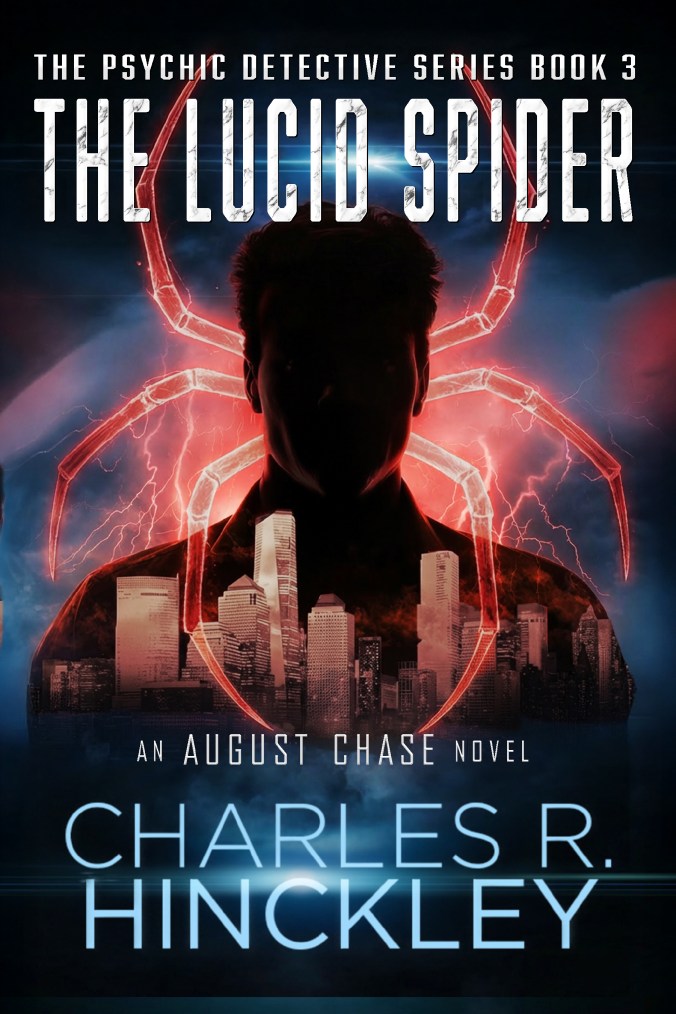
The Lucid Spider Book 3 of the psychic detective Series.

BOOK REVEIW!

ONLINE BOOK CLUB: The Lucid Spider: A Psychic Detective Novel by Charles R. Hinckley is the third volume in the series. The first two books are Dream State and Dreaming Wide Awake. Can you imagine thinking you have a spider in your head that will eat your brain if you don’t obey its instructions? Porter Grossman implants a psychic bug called the Lucid Spider into people’s minds so that he can control them. Gus Chase is a psychic private investigator who suffered at the hands of Grossman but managed to escape. Gus works with Mill, his millionaire business partner, and Jenny Lynch, a police detective, to investigate murders linked to Grossman. As a psychic, Gus sees visions of people in danger, murder scenes, and troubled victims. He has to manage his powers so they don’t overwhelm him. He is committed to using his abilities to save innocent people and uncover serious crimes. Gus’s psychic powers and Jenny’s policing skills combine to make a formidable team. I was immediately engrossed in the book. The story is well told and draws the reader in. The details about Gus’s psychic experiences are convincing and intriguing. He is a relatable character, and his relationships with Jenny and Mill are a strong part of the story. Jenny’s down-to-earth approach contrasts well with Gus’s psychic powers. There is humor in Gus and Jenny’s conversations, which lightens the mood against the backdrop of danger and menace.

There is a lot of dialogue in the text, which is a strength of the book. The dialogue is natural, has energy, and brings the narrative to life. There is an air of mystery and intrigue in the story, and the tension is created effectively. Readers interested in compelling crime fiction with strong characters and a psychic twist would enjoy this book. I have deducted one star for the point made in the paragraph above. The rating for this book is 4 out of 5 stars.

New ***** 5 star review

Saving Mozart

Charles R. Hinckley
Independently Published (2025)
ISBN: 979-8313537818
Reviewed by Terri Stepek for Reader Views (08/2025)

What if you could go back in time to save your personal idol from an untimely death?  Oh, but we know how this goes, don’t we? 

Novels involving time travel tend to have one big plot device in common; characters who think they can go back in time without causing the “Butterfly Effect,” something every sci-fi fan knows about.  The characters are always sure they won’t change history with their little adventure, and yet they always muck it up.  If you’re picking up Charles R. Hinckley’s Saving Mozart expecting something similar, you won’t be disappointed.  But you may be surprised that this is only the tip of the iceberg.  Hinckley has so much more in store for readers.

Protagonists Cal and Emily were childhood sweethearts who lost track of each other years ago.  They meet up again, unexpectedly, as grad students.  Cal is a composer who has studied his hero, Mozart, extensively.  He’s hoping to properly finish Mozart’s Requiem, which was unfinished at the time of Mozart’s early death.  He’s a right-brain thinker, through and through: creative, imaginative, and subjective.

Emily is into physics, and the team she’s working with has just figured out the secret of time travel.  She’s purely left-brained and logical; an analytical, sequential thinker.  Let’s face it, these two characters share very little in the way they see the world, and that is precisely what makes this time travel adventure so very unique and absolutely awesome.

Emily and Cal have a lively, age-appropriate banter.  They go from cutting each other down to having deep discussions in the blink of an eye.  They both display a marvelous sense of humor while maintaining great depth concerning their post-grad work.  They’re also thinking it just might be fun to get together again…maybe.  Okay, that oscillates a bit, depending on the day, the hour, and their location in time.

Hinckley has created an ensemble cast of professors and grad students who will inadvertently cross paths with people of 1790’s Vienna as well as one very scary antagonist who defies description.  The personalities here are well-defined and diverse, genuine and likable.  The reader is drawn to them even when they make incredibly bad decisions, because, well… we get it.  They’re human.  And flawed.  And even though Cal promises to follow the rules, he loses all sense every time he encounters Mozart.  The consequences of this are very bad—especially for Mozart.  Let’s face it, they don’t just encounter the Butterfly Effect- they smash that poor butterfly every time they go back.

I didn’t expect to find so much humor and humanity within this tale and was pleasantly surprised by how fun this story is.  I laughed, shook my head, rolled my eyes, and referred to certain characters in unflattering terms at times.  Yet I was completely hooked, even when I thought I knew what was coming.  Hinckley knows how to reel his audience in, and he does it with great finesse and wit.

 If you are a fan of time travel adventures, alternate history, or simply good action-adventure tales, don’t miss Saving Mozart.  I’ll go even further than that: if you simply enjoy a good thriller with accessible, well-written, characters and a plot that leaves you speechless while making you laugh at the ridiculous banter and I-told-you-so moments, click over now and grab the 5-star raucous read, Saving Mozart by Charles R. Hinckley.  It does not disappoint.

FIVE STARS!

A review from the Online Book club:

https://www.amazon.com/Saving-Mozart-Time-Travel-Adventure-ebook/dp/B0DZTYX6WV?ref_=ast_author_mpb

Time travel, masterful music, and intriguing interactions comprise the novel Saving Mozart: A Time Travel Adventure by Charles R. Hinckley. As someone who loves stories revolving around going back in time, this novel captured my attention in the first chapter, not only with the time-traveling element but also with the themes of music and meeting one’s life hero. These aspects created a unique plot and made it enjoyable to follow along.

Here’s a little about me and why I enjoyed this book so much: I have played the piano for years, though probably not as well as the main character, Calvin Hobbs. I understood the terminology that Calvin used when mentioning piano sheet music and reading scores of Mozart’s compositions. Another aspect that I appreciated about this book was that time travel became possible. Cal’s childhood sweetheart, Emily, explains, “Time is happening all at once. Everything in the past, everything in the future, is all happening at the same time. Like an explosion. Some call it the Block Theory, which postulates that there must be a simultaneous past and present, like it’s in a block.”

Saving Mozart: A Time Travel Adventure introduces many scientific and thought-provoking aspects that have further captivated my interest. The Grandfather Effect is mentioned alongside how impactful some events and people are to the course of existence, while others barely cause ripples. This novel focuses on the consequences that occur when we tamper with the status quo, regardless of if we believe we are doing it for the benefit of others, in this case, saving Mozart before his appointed passing. Having read other books about multiverses and worldlines, I found this plot was easier to follow than most. Sure, there were some moments when I had to slow down to understand the scientific concepts I was reading, but for the most part, the words, phrasing, and context were not beyond my intellectual level, which made the reading more enjoyable overall.

There was nothing I truly disliked about this book. Charles R. Hinckley, author of the novel, ensured that there were minimal errors, as I hardly found many. I would recommend this book to anyone, as it was not written with one specific group or genre in mind. Possible sexual scenes were kept appropriate, and only a few curse words were mentioned throughout the entire novel. Overall, I believe this book deserves a perfect rating of 5 out of 5 stars.

Island Girl Gets FIVE Stars!

from Online Book Club

“Island Girl” by Charles R. Hinckley is a concise 105-page read that captivates readers in a single sitting. Through the story’s protagonist, Garrett, the book explores the profound impact of loss, delving into themes of loneliness, sorrow, and despair. Following the tragic death of his family, Garrett spirals into a self-destructive pattern of alcoholism, driven by a sense of hopelessness. Similarly, the narrative sheds light on Jessica’s plight, illustrating how past trauma can influence one’s choices and lead to devastating consequences. Prepare to embark on an emotional journey as “Island Girl” delivers a poignant narrative that resonates long after the final page is turned.

The author’s skillful writing style seamlessly connects readers with the emotions and experiences of the characters. The character development, particularly of Bill, Jack, Garrett, and Jessica, was particularly captivating. However, what truly resonated with me was Jessica’s final resolution, which not only endeared her to me but also provided deeper insight into her character.

The book unfolds at a measured pace, interrupted by intense attack scenes that inject urgency into the narrative. Upon reaching the final page, readers are left with plenty to reflect upon. With its impeccable editing and clear, easily understandable language, I have no reservations about awarding it five out of five stars. This book is a must-read for fans of the crime and mystery genres, offering a captivating and well-crafted storytelling experience. Online Book Club